
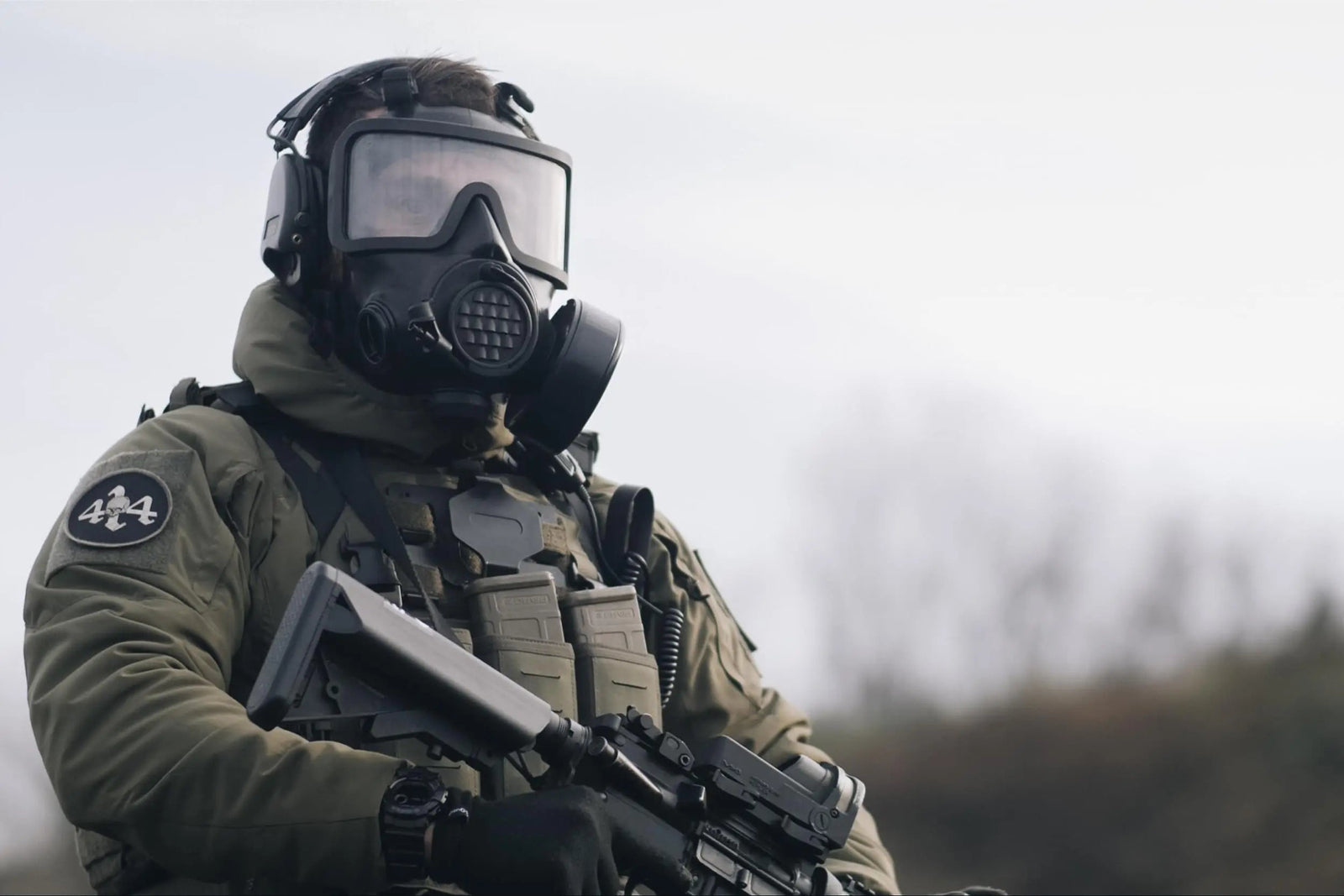
How does a company end up supplying respiratory protection to families, first responders, and government agencies across North America, starting with zero industry connections, zero funding, and a founder who arrived in this country as a refugee?
I've never told this story in full before. I'm telling it now because our customer base has changed. What started as a direct-to-consumer preparedness brand has grown into something agencies, procurement officers, and institutional buyers rely on; and I think you deserve to know who you're actually working with, not just what's on the spec sheet.
This is the story of how MIRA Safety got built, the manufacturing relationships that make our equipment possible, the mistakes that shaped how we operate today, and where we're headed next, including our push toward domestic manufacturing.
Why This Matters to You
If you're evaluating MIRA Safety as a vendor - for an agency, a department, a distributor relationship, or a bulk contract - you're not just buying a product. You're choosing a supplier you'll need to trust during the moments when it matters most: a shortage, a surge in demand, a crisis that stresses every supply chain at once.
I want to be transparent about how we got here, because our history is the best evidence of how we'll perform when things get hard. We've been tested by real shortages, real export restrictions, and real demand surges that would have broken a less committed operation. I'd rather show you that record than just tell you about it.
This is also, honestly, for our team and our manufacturing partners, a shared reference point for why we do things the way we do.
Where This Started: Moscow, 9/11, and a Gap in the Market
I was born in Moscow and came to the U.S. as a refugee in the early 1990s, during a period of severe scarcity in Russia, including rationing, shortages, and a currency in freefall. The Chernobyl disaster happened the year I was born, and growing up in its cultural aftermath gave me an early, visceral understanding of something most people never think about: catastrophic events happen without warning, and most people have no plan for them.

Source: Personal Archive
We settled in New York, and in 2001 I was a student at Fort Hamilton High School, close enough to Manhattan to watch the towers fall in person. In the aftermath, as reporting on respiratory illness among first responders and Ground Zero workers emerged, I kept coming back to one fact: basic respiratory protection - something as simple as a half-face respirator - could have prevented a significant share of the long-term health damage suffered by people who worked or lived nearby.
That's the founding insight behind MIRA Safety. Respiratory protection is not a niche or a novelty item. It's foundational infrastructure for individual and public safety, and at the time, the market for it was split cleanly in two: military-grade equipment locked up inside defense-only supply chains, and low-quality consumer products with no real protective standard behind them. Nothing serious existed in between, for families, for smaller agencies, and for anyone who wasn't already inside a defense contract.
The Long Road to a Real Business
I spent my early career in sales, cold-calling for a Wall Street firm, then waiting tables in Times Square after that job collapsed. Neither was glamorous, but both taught me things that matter more in this business than an MBA would have: how to build rapport with a skeptical buyer, how to handle rejection without flinching, and how to stay useful when nobody owes you anything.
In 2011, a friend and I built a small direct-to-consumer preparedness company, "Ready to Go Survival," selling custom bug-out kits. A New York Times feature drove a short burst of sales, followed by the much harder work of building a sustainable business with no outside funding. That business never became profitable on its own, but it put me through thousands of consultations with people trying to figure out what equipment they actually needed. This data shaped every product decision we've made since.
By 2017, a cease-and-desist letter from an Italian respirator manufacturer over a listing dispute forced the issue: we needed our own supply chain, not someone else's. That setback is the direct reason why MIRA Safety exists.
Building the Supply Chain: How MIRA Safety Actually Came Together
We approached Avon Protection first, since they were the dominant name in military-grade respiratory protection at the time. Their answer was clear: no interest in civilian distribution, full stop.
So we looked further and found something better suited to what we were trying to build: a Czech Republic manufacturer with a century of history producing respirators for the Czech military and government agencies, and a strong regional tradition of civil defense equipment. Since Eastern Europe has a long-standing culture of civilian preparedness, they were open to a partnership that Western defense manufacturers weren't.
Their flagship product, the CM-6M, gave us a respirator platform that combined:
-
Butyl rubber construction for chemical agent resistance
-
A speech diaphragm
-
An integrated drinking system compatible with standard canteens
-
A panoramic field of view
At the time, nothing at that spec level existed under $400 in the civilian-accessible market. We paired it with filtration from a second Czech manufacturer, founded by a former Czech special forces CBRN specialist, whose filter performance outpaced everything else available to us.
We named the resulting brand MIRA Safety. "Mir" meaning peace and world in several Slavic languages, and "mira" meaning "to look" in Spanish, which felt appropriate for a company built around maintaining visibility and awareness in hazardous environments.
From there, my wife and I ran fulfillment out of a spare bedroom, ordering a few hundred units at a time. It wasn't sophisticated. It was, however, the start of a direct relationship with manufacturers that, today, gives us exclusive North American distribution rights and retail exclusivity for several European defense-grade PPE lines, including Gumarny Zubri, Avec Chem, Trayal, Supergum, and DPI (a Leonardo company).
In several cases, we've gone further than distribution and worked directly with manufacturers to adapt military-spec designs for broader accessibility. For example, converting the MD-1 children's gas mask from proprietary Trayal threading to standard 40mm NATO threading, and upgrading its material from natural rubber to butyl rubber for better resistance to blister agents. With Kappler, we co-developed new sizing for the HAZ-SUIT® to include children's sizes that hadn't previously existed in the market at all.

Source: MIRA Safety
Proof Points: TENET and the 2020 Surge
In 2019, our equipment was selected for Christopher Nolan's film Tenet, which put our respirators in front of a global audience the year before mask demand became a defining feature of daily life everywhere. It was a small, strange bit of good timing, but it wasn't the moment that actually tested us.
That moment came in January 2020. We were exhibiting at SHOT Show when demand for our products began doubling, day over day, well before general awareness of COVID-19 had spread in the U.S. It wasn't marketing, it was simply the earliest visible signal of a demand curve that would eventually hit the entire PPE industry. Because respiratory protection sits at the base of Maslow's hierarchy - air, before water, before food, before anything else - we felt the surge first.

Source: MIRA Safety. Our company at SHOT Show, 2020.
We're candid about what happened next: our infrastructure wasn't ready for it. We scaled fulfillment from a bedroom, to a garage, to storage units, to multiple RV units; built out customer service on the fly, and still accumulated a six-month backorder at the peak. Some customers had a bad experience with us during that period, and we own that fully. It's one of our clearest operational lessons (more on that below).
However, the underlying resilience mattered: when Amazon suspended PPE listings that February, an SEO position we'd built over years kept us visible and operating. When European export restrictions on strategic goods extended lead times industry-wide, our existing manufacturing relationships kept product moving. The business roughly doubled again in 2022 following Russia's invasion of Ukraine: a pattern we've come to think of, grimly, as a fairly reliable indicator of geopolitical risk.

Source: MIRA Safety. Fulfilling orders from one of our first storage units.
The takeaway for anyone evaluating us as a supplier: we have direct, tested experience operating through exactly the kind of demand shocks and export disruptions that matter most to institutional buyers planning for surge capacity.
Scaling Into an Institutional Supplier: 2023–2025
In 2023, we moved into a permanent 26,000 sq ft headquarters and fulfillment facility in Cedar Park, Texas, completing a full renovation in April 2025. The build-out reflects a long-term view of the company: proper warehouse management systems, dedicated customer service infrastructure, and a workplace designed to retain the kind of team that a defense-adjacent supplier needs to keep around for the long haul.
We're actively hiring preparedness-minded people who want to work in this space long-term: engineering, operations, sales, and account management, including roles focused on institutional and agency accounts.
What We Believe, and How We Operate
MIRA Safety runs on a civilian-first philosophy: whatever standard of protective equipment is available to professionals should also be available to civilians, families, and smaller agencies, not gatekept behind defense-only procurement channels. That principle shapes our whole product strategy, including our continued investment in children's protective equipment, a category we remain one of very few global suppliers of.
Four values guide how we operate day to day:
-
Adaptability - building a business around low-probability, high-consequence events means the ability to shift fast when circumstances change, is not optional.
-
Accountability - when we get something wrong, we say so plainly, to customers and to each other.
-
Teamwork - we don't believe individual talent substitutes for coordinated execution, especially at scale.
-
Tenacity - most of our hardest years didn't get easier because a market shifted in our favor. They got easier because we didn't stop.
We've also stayed independently owned - no outside investors, venture capital, or private equity — specifically so that decisions about quality, sourcing, and mission stay in the hands of the people who built the company, rather than being subject to shareholder pressure. For a partner evaluating vendor stability, that matters: our incentives are aligned with long-term product integrity, not quarterly optics.
Lessons From the Hard Way
We'd rather be upfront about where we've fallen short than pretend the growth curve was clean.
We under-invested in fulfillment infrastructure during 2020's surge. We should have engaged a third-party logistics partner and implemented a proper warehouse management system before demand spiked, not after. That gap produced real delays and real frustrated customers, and we've since rebuilt our fulfillment operation from the ground up to prevent a repeat.
Customer service scaled too slowly. For a period, resolution depended heavily on which team member you happened to reach. We've since standardized procedures and expanded the team specifically to eliminate that inconsistency.
We learned the hard way that outsourced marketing agencies don't always protect brand values. An agency managing part of our affiliate marketing distributed products to partners whose values conflicted with ours. We corrected it once we identified the issue, but it reinforced our preference for keeping brand-sensitive functions in-house, especially anything involving how our name and products are represented publicly.
We share this because any procurement partner should want to know not just what a vendor does well, but how they respond when something goes wrong. We'd rather you hear it from us first.
Straight Answers to Questions We Get From Buyers
Is MIRA Safety a manufacturer or a reseller? Neither term fully fits. We're the exclusive North American retail and distribution arm for several European defense-grade PPE manufacturers, companies that have historically sold only to their domestic militaries and agencies. In several cases, we've co-developed product modifications with these manufacturers (thread standardization, material upgrades, new sizing) rather than simply reselling an existing catalog. We handle sourcing, quality control, compliance, customer support, and market access that these manufacturers weren't previously positioned to provide in North America.
Why is MIRA priced above some competitors? We operate a 26,000 sq ft U.S. facility, maintain domestic inventory, and invest in quality control and support infrastructure that a pure import-and-resell operation doesn't carry. If landed cost is the only variable that matters to your procurement process, we're probably not the cheapest option on the table. If reliability, consistent stock, and a single point of accountability across a specialized product line matter more, that's where we compete.
Is the CM-7M just a rebadged surplus OM-90? No. We've never sold surplus equipment. The OM-90 is the Czech Armed Forces' current-issue respirator, and exporting it commercially requires an End-User Certificate from the Czech government, since it's a controlled military item (comparable to Avon's M50). The CM-7M is the commercially exportable version of the same platform, built new, not pulled from surplus stock. This distinction matters for any buyer concerned about chain-of-custody or provenance.
Do your products actually outperform lower-cost alternatives for CBRN use? For genuine CBRN exposure scenarios, yes. Our masks use bromobutyl rubber construction and components tested to military specification, which matters materially for chemical agent resistance. For basic particulate or dust filtration, a lower-spec option may be entirely adequate. We're happy to help a buyer scope the right product to the actual threat profile rather than defaulting to the highest-spec option.
Are these designs outdated? The CM-7M/OM-90 platform dates to the 1990s, and we don't hide that. What that also means is two decades of field use, refinement, and validated performance across multiple agencies globally, not an unproven design still working out failure modes. For safety equipment, a long field record is generally a feature, not a liability.
What about the 2020/2022 delivery issues? Covered above, honestly: real problems, since remediated with better systems, more staff, and clearer communication protocols.
Where We're Headed: Domestic Manufacturing
Our current production is based primarily in Europe, which has served customers well. However, 2020 also demonstrated the risk in that arrangement, when European governments restricted export of strategic PPE commodities during the exact period global demand spiked. That's a resilience gap we're closing.
We've already taken that step. Domestic assembly lines are up and running, and the CM-6M is now available assembled in the U.S. This is the first concrete result of bringing our manufacturing capability home. This matters both for the supply chain independence it provides institutional buyers and, frankly, because "Made in the USA" carries real weight in procurement decisions for a reason.
Working With MIRA Safety
Our mission is straightforward: professional-grade protective equipment shouldn't be locked inside defense-only procurement channels. Whatever we make available to agencies, we make available to everyday buyers; and whatever standard we hold for civilian sales, we hold for institutional accounts too.
If you're evaluating us for an agency contract, a bulk order, or a distribution relationship, I'd encourage you to weigh not just the spec sheet, but the track record behind it: a decade of operating through real shortages, real export restrictions, real demand shocks, and a straight account of what we got wrong along the way.
We're always open to a conversation with procurement teams, emergency management agencies, and institutional buyers. Reach out through our contact page, and we'll walk you through the right product fit for your use case.
About the author

