I worked Ground Zero. Nobody deconned us. We climbed off the pile, drove home in the same clothes, hugged our kids, and threw the uniform in the family hamper. In the years since, more of my brothers and sisters have died from what we breathed and carried home than died on the day itself. More than 350 and counting. So when I tell you that decontamination is not a footnote to your protective equipment program, understand that I am not making a sales argument. I am reading you a casualty list.
Here is the hard truth about exposure: the incident does not end when the scene is secured. It ends when the contamination is off your people, off their gear, out of their vehicles, and documented. Everything between those two points is decon, and most agencies have never budgeted a dollar for it.
This guide covers what decon actually is, the equipment that belongs in your fleet, and how to build it into policy before the day you need it.
The Exposure Does Not End When the Call Does
Every agency buys the mask eventually. Almost nobody buys what comes after the mask, and that gap has a body count. A gas mask keeps contamination out of your officer’s lungs for the duration of the exposure. It does nothing about the contamination sitting on his uniform, his boots, his cuffs, his rifle, and the back seat of his sector car when the call ends. That material does not evaporate out of respect for the end of tour.
Look at where it actually rides home:
• Fentanyl residue. Powder on a uniform sleeve from a warrant or an overdose scene, transferred to the steering wheel, the report-writing desk, and eventually the officer’s face. The medical debate about casual exposure is ongoing. The contamination-control answer is not debatable: get it off, correctly, every time.
• Riot agent residue. CS and OC don't necessarily stop being a problem when the crowd goes home. CS residue can remain on gear, uniforms, and inside vehicles long after an incident, where it may be re-aerosolized or transferred through routine handling. OC can also contaminate equipment and cause secondary exposure, particularly if officers touch contaminated surfaces and then their eyes or face. Proper decontamination protects not only the officer wearing the gear, but everyone who handles it afterward.
• Clandestine labs and chemical scenes. Hazardous chemicals don't care that the incident is over. If they're on your boots, your uniform, or your gear when you leave, you've just moved the hazard from the scene to your patrol car, your station, and potentially your home. That's exactly what decontamination is designed to prevent.
• The take-home problem. This is the one that should keep command staff up at night. Contamination that leaves the scene on an officer goes home to a spouse, a kid, and a washing machine that handles the whole family’s laundry. Ground Zero taught us this lesson at maximum price. There is no excuse for any department to learn it twice.
Secondary contamination is not a theory. It is the default outcome of every exposure that is not followed by deliberate decon. The meter keeps running until you stop it.
The Three Levels of Decon Every Agency Needs
Decon is not one thing. It has three distinct capabilities, and confusing them is how departments end up owning the wrong equipment.
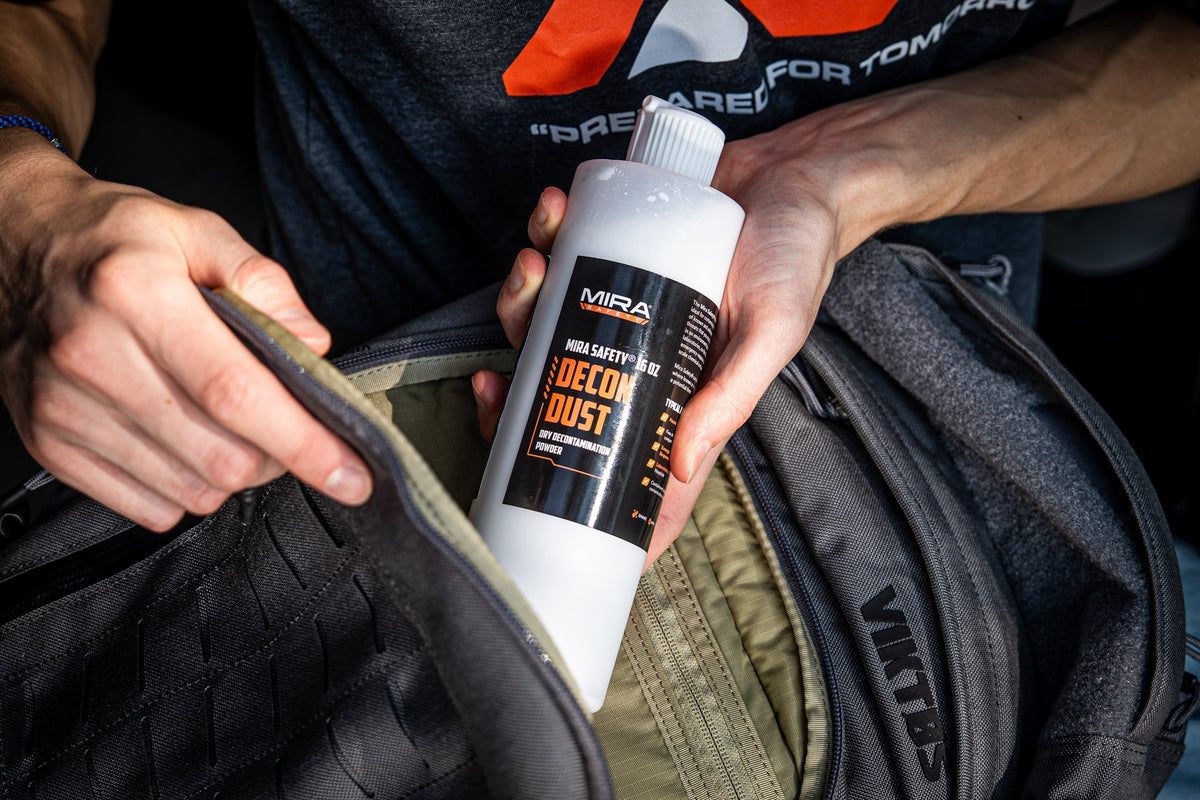
Level one: immediate personal decon. This is the officer-carried capability, the answer to “I just got it on me and I am still on the street.” It means dry decontamination first, because dry decon, wiping and adsorbing the agent off skin before it spreads or absorbs, does the majority of the work in the first minutes, and minutes are the entire game with chemical exposure. A personal decon mitt or wipe kit lives on the officer or in the go bag, gets deployed in under thirty seconds, and buys the time to reach the next level. If your officers carry tourniquets for the bleeding they might see, they should carry decon for the exposure they will.
Level two: technical decon at the scene or station. This is the structured version: a designated dirty side and clean side, doffing in sequence, bagging and tagging contaminated gear, washing exposed skin, and documenting everything. Think of it the way detectives process a crime scene after a search warrant. You don't have everyone wandering around hoping for the best. You establish a process, assign responsibilities, work methodically from one area to the next, and have another officer monitoring to ensure nothing is missed. Decontamination works the same way. One line on the ground separates dirty from clean. Contaminated material stays on one side of it, and officers don't cross until they've properly shed what they're carrying. It takes tape, bags, a wash capability, and—most importantly—a well-rehearsed procedure. Like any other critical operation, success comes from training before the incident, not improvising during it.
Level three: mass decon support. The chemical release at the transit hub, the white powder event with forty exposed civilians. Fire and hazmat own the big showers, but police own the perimeter, the corridor control, and the first minutes before the trucks arrive, and officers working inside that problem need their own protection and their own decon plan. An agency that plans to be at the incident has to plan to leave it clean.
Here is the sequence rule that governs all three levels, and it comes straight from doctrine that has not changed in decades: removing the outer layer of clothing eliminates the large majority of surface contamination on a person. The single highest-value decon action available is taking the jacket off correctly, rolled away from the face, and bagging it. Best trade your officer will make all shift. Everything else in the program builds on that move.
Decon Equipment That Belongs in Your Fleet
The market will sell you anything with the word decon on it. Here is what earns its space.
Personal decon kits, issued per officer. Dry decon mitts or wipe systems rated for chemical agents, small enough for a cargo pocket or patrol bag, and simple enough to deploy with gloved hands. The test is straightforward: can a stressed officer use it on themselves or a partner in under a minute without reading instructions? If the product requires mixing, activation, or waiting for the decontamination media to be ready before it can be used, it belongs at a decon station—not in an officer's pocket. Personal decontamination equipment should be ready the moment it's needed, because chemical exposures don't wait for preparation.
Decon station consumables, staged in supervisors' vehicles. Heavy contractor bags for contaminated gear, tags and markers for chain of custody, barrier tape to establish the dirty line, nitrile gloves in quantity, wipes, and a dedicated technical decontamination kit. None of this is exotic, yet it's often missing the first time an agency needs it because no one planned for what happens after the incident. A complete station kit fits in a single duffel bag and costs less than a single set of court overtime. Even better are self-contained decontamination systems that arrive operationally ready, require no mixing or activation, and provide officers with a standardized process under stress. The easier the system is to deploy, the more likely it is to be used correctly when seconds matter.
Portable wash capability. For station-level technical decontamination, agencies should have access to a low-pressure rinse system, mild soap, soft brushes for equipment, and a plan to contain contaminated runoff. The goal is to remove contamination—not spread it. High-pressure streams can aerosolize contaminants, increase splash, damage equipment, and make contamination control more difficult. A controlled, methodical approach is more effective than simply blasting everything with water.
Mask and equipment decon supplies. Your respirators, the ones the first article in this series told you to buy, survive their service life only if they are cleaned correctly after every exposure. Mild soap, full drying, and inspection, with filters treated as contaminated waste after chemical exposure, not as reusables. A department that deploys masks without a decon-and-reset pipeline owns single-use equipment at multi-use prices.
What does not qualify. Baby wipes as a chemical agent plan. A garden hose and hope. And the classic: nothing at all, plus the assumption that fire will handle it. Fire handles the civilians and the hot zone. Your officers, your gear, and your vehicles are your problem, and they will still be your problem three days later when the sector car smells like CS every time the heater runs.
Building Decon Into Training and Policy
Equipment without procedure is a duffel bag of good intentions. Three things turn it into capability.
Train the doffing sequence until it is boring. Contaminated gear comes off in an order, outer layer rolled away from the face, gloves handled so clean hands never touch dirty surfaces, mask off last, straps back to front. Done right, the contamination leaves when the gear does. Done wrong, the doffing is the exposure. This is a living-room drill, ten minutes at roll call quarterly, and it pays like nothing else in the training budget.
Buddy decon. Decontamination is rarely a one-person job. An exposed officer should be decontaminated under the supervision of another officer, because stress, tunnel vision, and contaminated gloves make it easy to miss steps or inadvertently spread contamination. Once the exposed officer has completed the process, the assisting officer should evaluate their own protective equipment and complete decontamination as needed. Like any critical police operation, a second set of eyes catches the things the primary officer may miss.
Document the exposure. Record who was exposed, the suspected contaminant, the duration of the exposure, what decontamination was performed, and what happened to contaminated equipment. Good documentation protects everyone. It provides a medical record for the officer if health concerns arise years later, helps identify trends if multiple personnel are affected, and demonstrates that the agency followed established procedures. Ground Zero taught many of us how important those records can become. Thanks to good documentation, many responders have had legitimate World Trade Center-related illnesses recognized and covered through the WTC Health Program and Victim Compensation Fund. Others haven't been as fortunate and continue to fight to prove exposures that were never adequately documented. Don't assume today's incident will only matter today. The report you write now may be the document that protects an officer's health, benefits, and family years from now.
How to Build the Decon Program for Your Agency
Scale by role, standardize by procedure. Every officer carries personal decon and knows the doffing sequence. Every supervisor’s vehicle stages a station kit. Specialty units, SWAT, narcotics, crime scene, carry the deeper capability their exposure profile demands. Different equipment loads, one procedure, so that any officer can run any decon line in the department.
Budget honestly. Full personal decon for an entire patrol division costs less than a single vehicle. Compare that number to one presumptive exposure claim, one contaminated fleet vehicle out of service, or one family exposure lawsuit, and the procurement argument writes itself. This is the cheapest insurance your agency will ever be offered.
Buy the paperwork with the product. Certified products with documentation qualify for the same DHS and state preparedness grant streams as the rest of your CBRN equipment. Ask vendors for the certification package, the training support, and the shelf-life data up front. A decon product with no expiration data and no test reports is a costume, and you already know how I feel about costumes.
Test it against your real world. Run one full technical decon evolution at your own station with your own people before you standardize anything. You will find the gaps in twenty minutes, the missing chair, the bags that tear, the step nobody owns, and finding them in training costs nothing. Finding them at 2 a.m. behind a chemical scene costs everything the gap can reach.
The Bottom Line
Protection gets your officers through the exposure. Decontamination is what ensures the exposure doesn't leave the scene with them. An effective program has three components: personal decontamination, technical decontamination, and mass decontamination support. Build your procedures, train them until they're second nature, and equip your people with the tools they need before the incident - not during it. The goal isn't simply to survive the call. It's to make sure your officers return home without bringing the hazard with them.
MIRA Safety builds certified decontamination and CBRN protective equipment for law enforcement, tactical teams, and first responders. Explore the decontamination product line, or contact the team for department evaluation samples, bulk pricing, and a formal quote. Send your people home clean. Every shift, every scene, every time.
Frequently Asked Questions
What are the three levels of decontamination for law enforcement?
What is the single most effective decon action an officer can take?
What should be in a personal decon kit?
Why is dry decon done before washing with water?
What is secondary contamination and why does it matter for law enforcement?
About the author