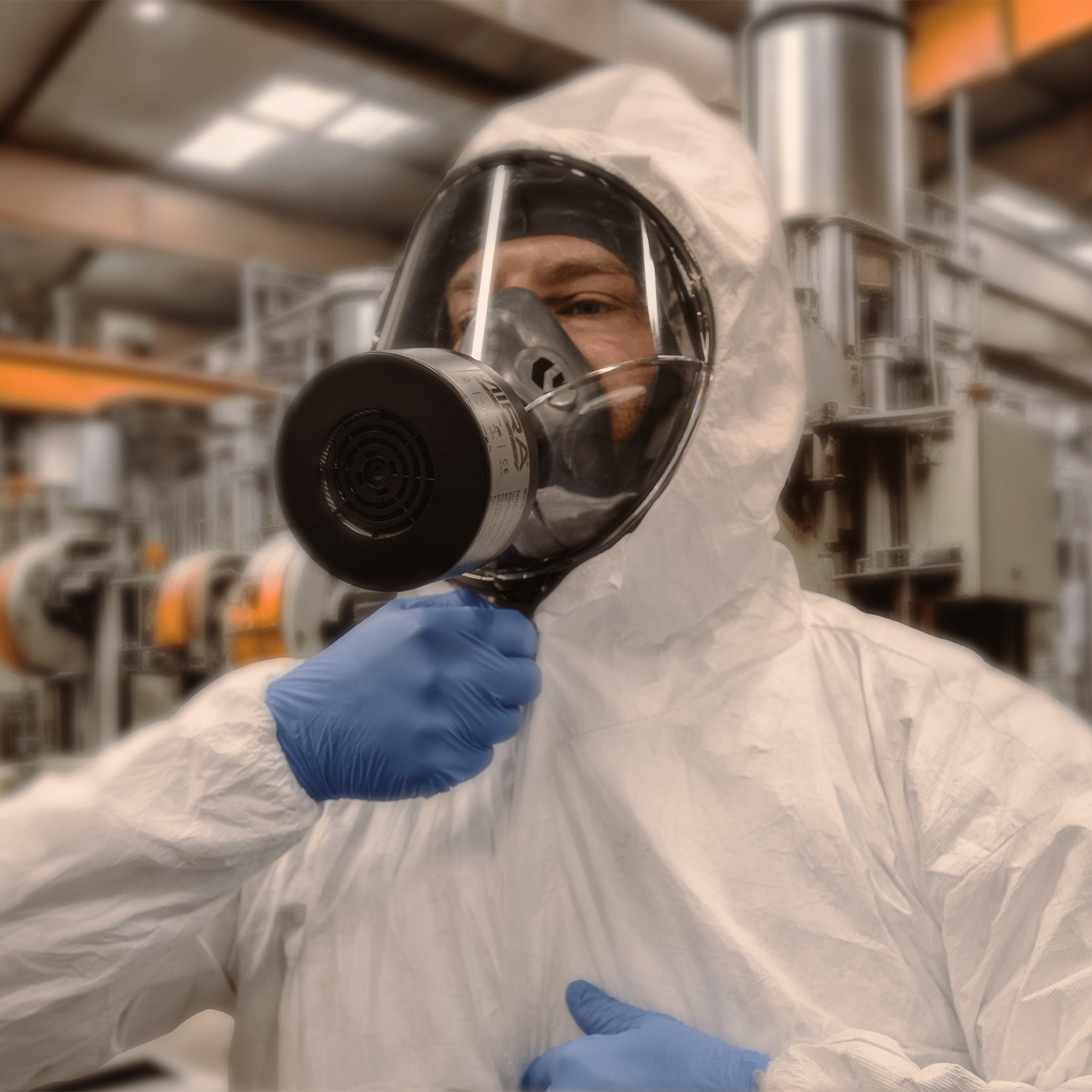
I spent years on the NYPD SCUBA Team, and a drysuit was the most honest instructor I ever had. It didn't care about your rank, your reputation, or what the catalog promised. If a wrist seal, neck seal, or zipper leaked four miles off Brooklyn in black February water, you found out in about three seconds. It taught a lesson that's just as true for chemical protective clothing: a suit is only as protective as its weakest point. More often than not, that's the seals, seams, or closures; not the material itself.
That lesson is the entire subject of this article. Your agency has probably bought masks by now. Some of you have built the decon program from the last piece in this series. The third leg is skin protection, and it is the one the market lies about most fluently, because anything shaped like a hazmat suit photographs like protection whether it protects or not.
This guide covers how to tell a certified CBRN suit from an expensive costume, what completes the ensemble, and how to field it across your department. Let’s work.
Why a Coverall Is Not a CBRN Suit
The suit market splits into theater and equipment, and the split is visible in the paperwork. A painter’s coverall or a rain poncho sheds water, tears at the first fence, and seals at nothing. A certified protective suit comes with test data against recognized standards for barrier integrity, and at the higher tiers, against chemical warfare agents and toxic industrial chemicals. If the packaging names no certification standard, you are holding a costume, and a costume on a chemical scene is worse than nothing, because the officer wearing it behaves like he is protected.
Now look at where police skin actually meets the threat:
• Clandestine labs. Fentanyl, meth precursors, and improvised chemistry on every surface. The officers processing that scene are in contact with it for hours, and nitrile exam gloves with a prayer is not a protection plan.
• Chemical suicides and hazmat scenes. Patrol gets there first, makes the approach, and often makes the rescue attempt before hazmat is even rolling. That approach happens in whatever the officer is wearing.
• Biological scenes. Decomposition, bodily fluids, disease outbreaks, mass casualty events. Crime scene and warrant work put officers into biological exposure weekly, and the uniform absorbs all of it.
• Radiological response. A dirty bomb is a contamination weapon aimed at exactly the people who run toward the explosion. The suit’s job in that environment is simple: keep the particles off the skin and leave with them when it comes off.
One honest sentence organizes everything that follows: the suit exists for movement and work inside contamination, and its second job, being removable so the contamination leaves when it does, matters exactly as much as the first.
What Are The HAZMAT Suits Classifications?
The EPA’s Level A through D classification system is the starting point for every suit conversation, and it’s worth reviewing plainly because the distinctions matter operationally, not just on paper.
| Level | Protection | Typical Use | Notes |
|---|---|---|---|
| A | Fully encapsulating suit + SCBA | Unknown substance, highest vapor/skin threat, entry team ops | Maximum protection, maximum heat stress — shortest safe work duration |
| B | Chemical-resistant suit + SCBA, not fully encapsulating | Known substance requiring high respiratory but lower skin protection | Common HAZMAT team entry level for identified liquid splash hazards |
| C | Chemical-resistant suit + air-purifying respirator | Known substance, concentration and type allow APR use | Requires confirmed air monitoring data before downgrading from B |
| D | Standard work uniform, minimal chemical protection | Support zone, no direct contact expected | Not for hazmat entry — support and staging roles only |
Which level applies depends on agency function as much as the substance itself. HAZMAT teams typically train and equip across B through D depending on the call. Fire departments doing dual-role hazmat response often standardize on Level B/C entry gear paired with their existing SCBA.
Law enforcement units supporting a hazmat scene, securing a perimeter, assisting with evidence collection in a clan lab, usually operate in Level C or D depending on confirmed air quality readings from the entry team, and should never assume Level D is adequate without that confirmation in hand.
NFPA 1994 and 1991 govern suit performance standards for chemical, biological, and terrorism-related incidents, while OSHA 1910.120 sets the regulatory floor for hazardous waste operations and emergency response (HAZWOPER) training and PPE requirements. An agency’s suit inventory should be selected against both standards, not just whichever one a particular vendor happens to certify against - ask directly which NFPA classification each suit in a proposal actually carries, and get it in writing.
Key Features to Look for in a CBRN Suit?
Certification you can read. Demand test documentation against recognized protective clothing standards, the NFPA 1990 family and the equivalent EN standards for the class you are buying, with the specific agents and challenge chemicals listed. “Hazmat style” is a description of the silhouette. A certification is a description of the testing. You already know which one stops chemicals.
Barrier integrity where suits actually fail. Suits do not fail in the middle of the chest panel. They fail at the zipper, the hood, the cuffs, and the ankles, which is precisely where the cheap products save their money. Look for sealed or covered zipper systems, an elastic hood designed to mate with a full-face respirator, and cuffs built to interface with gloves and boots. Fallout is grit, chemical residue is liquid, and both share one talent: finding gaps. The interfaces are the gaps.
Durability for police work. A law enforcement officer operating in a protective suit isn't working on a clean laboratory floor. They may be moving through cluttered residences, industrial facilities, warehouses, or other environments filled with debris, sharp edges, and snag hazards. The suit must withstand abrasion and incidental contact without compromising its protective barrier, because a tear isn't simply cosmetic—it can become a pathway for contamination. Ask for tear and puncture resistance data, and evaluate it against the environments your officers are most likely to encounter, not just the conditions demonstrated on a trade show floor.
Sizing for the mission. Protective suits are intentionally sized larger than everyday clothing to provide freedom of movement and accommodate the clothing or equipment worn underneath. Depending on the mission, that may include a uniform and, in some cases, body armor, while duty belts and other equipment are often worn outside the suit. Think of wearing a sport coat that's one size too small—you can put it on, but the moment you reach across your body or extend your arms, the shoulders bind and your mobility disappears. The same principle applies to protective suits. Before making a department-wide purchase, conduct a sizing trial. Have officers don the suit with their typical operational gear and move through realistic motions such as kneeling, climbing stairs or stepping over low obstacles, reaching overhead, and shouldering a long gun. A properly sized suit should allow full range of motion without excessive restriction or placing unnecessary stress on the seams.
Heat burden, stated honestly. An impermeable suit is a personal sauna, and heat casualties take more responders out of chemical incidents than the chemicals do. The suit choice sets the work-rest ratio: heavier barrier, shorter work cycles. Buy the protection level the mission requires, then write the rotation schedule the suit requires, because the officer who ignores both is the next patient at his own scene.
The Suit Is the Easy Part: Completing the Ensemble
Here is the sentence I want stenciled inside every equipment room: the suit is the easy part. The seams are the equipment. A certified suit with bare hands, duty boots, and an open neckline is a costume with a certificate, and completing the system costs a fraction of what the suit did.
Gloves. Butyl rubber over a nitrile liner is the working standard: the liner handles the doffing hygiene, the butyl handles the chemistry. Duty gloves and bare nitrile are for evidence handling, not chemical protection, and every officer who has learned that distinction the hard way agrees with me.
Boot covers or chemical boots. The ground is the most contaminated surface at any scene, and duty boots are sponges with laces. Overboots or dedicated chemical boots close the bottom of the system and, just as important, stay at the dirty line instead of walking the scene into the sector car and the station house.
Taping interfaces. Whether glove, boot, and hood interfaces should be taped depends on the protective suit, the manufacturer's instructions, your agency's SOPs, and the anticipated hazard. Many modern protective suits are designed to provide an effective seal without taping when properly donned, while other applications may call for chemical-resistant tape to reinforce those interfaces. If taping is part of your protocol, make it part of your training - not an afterthought on scene. Officers should be able to apply tape correctly and consistently, ensuring it enhances the protective system without unnecessarily restricting movement or complicating doffing.
The mask interface. The hood must seal around the respirator from the first article in this series, which is one more reason to buy the system instead of collecting parts. A hood fighting a mask for the same real estate on an officer’s face means both are losing.
Training: The Doffing Is Where the Exposure Happens
A suit that did its job all day can undo everything in the minutes it takes to remove it wrong, because at end of tour, everything the officer walked through is on the outside of that suit, inches from his face and hands.
Drill the doffing sequence until it is boring. Tape cut or peeled, suit rolled down and away so the contaminated exterior folds into itself, gloves off last with the liner technique, mask off after the suit, straps back to front, everything into the bag on the contaminated control zone side of the line. This choreography connects directly to the decon procedures from the second article in this series, and it is a ten-minute roll call drill that pays for itself the first time it is needed.
Practice in full kit, with sweat. Stress steals fine motor control and working memory, and a fogged, exhausted officer at the end of a scene is the person doing the doffing. The department that has run the sequence in training does it on autopilot. The department meeting it for the first time does it wrong, at the exact moment wrong costs the most.
Storage and shelf life. Suit materials age, seals age, and heat accelerates all of it. Suits live indoors in climate control, not in the trunk oven, with manufacture dates and shelf lives logged the same way you log the filters. Surplus suits of unknown age get the same verdict as surplus masks and surplus filters: “military grade” describes who bought it, not what decade it can still do the job.
How to Field Suits Across Your Agency
Match protection to role. Patrol needs a rapid-donning certified suit staged in the trunk kit for the unknown approach, one per officer, vacuum-sealed, dated. Narcotics, warrant teams, and crime scene units need reusable-grade protection matched to routine exposure. A hazmat co-response or tactical CBRN element steps up to the higher-tier ensembles with the training hours to match. Different tiers, one doffing procedure, one decon standard.
Budget with the vest analogy. A certified suit ensemble per officer costs a fraction of a ballistic vest, and it defends against a threat category the vest ignores completely. The no-name import saves pocket change per unit and deletes the certification, the documentation, and the grant eligibility in the same stroke. That is not procurement. That is liability with free shipping.
Buy the system, the sizes, and the paperwork. Ensembles from one maker mate at the interfaces by design. Sizing runs fit real bodies over real kit. Certification packages feed straight into DHS and state preparedness grant applications. Ask for all three before the purchase order, and treat any vendor who hesitates on documentation as having answered your question.
The Bottom Line
Skin protection comes down to the same test as everything else in this series: paperwork over appearance. Choose certified protection instead of a convincing silhouette, properly fitted interfaces instead of assumptions, and gloves, boots, and other components that work together as a complete protective system rather than relying on the suit alone. Finally, train the doffing process with the same discipline as the response itself, because contamination is just as likely to occur when removing PPE as when wearing it. The drysuit taught me a lesson decades ago that still applies today: every protective system has a weakest point. In chemical protective clothing, it's often the seals, seams, closures, and interfaces; not the fabric itself. Protect those, inspect them, and never assume the suit alone is what keeps you safe.
MIRA Safety’s HAZ-SUIT line and CBRN ensemble components, gloves, boot covers, and full-face respirators built to work as one system, are trusted by law enforcement and first response agencies worldwide. Explore the protective suit line, or contact the team for sizing runs, department evaluation units, and a formal quote. Suit your people like the seams matter. Because the seams are the equipment.
Frequently Asked Questions
What is the difference between a HAZMAT suit and a regular coverall?
What are the EPA Level A through D HAZMAT suit classifications?
Where do CBRN protective suits typically fail?
What NFPA and OSHA standards apply to law enforcement CBRN suits?
Do CBRN suit interfaces need to be taped for a proper seal?
About the author